
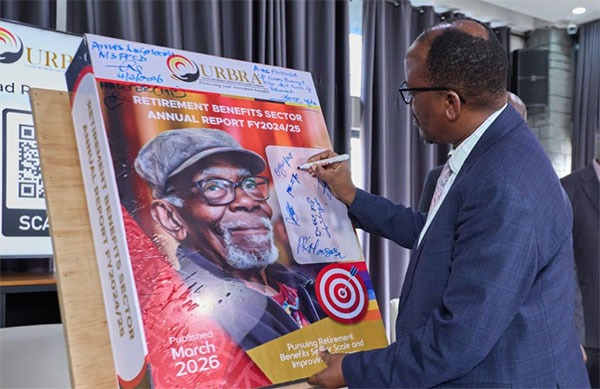
Uganda’s pension industry has recorded significant growth, with total retirement assets rising to Shs30.7 trillion from Shs25.4 trillion in the 2023/24 financial year, according to the latest sector report released by the Uganda Retirement Benefits Regulatory Authority.
The report shows that the number of Ugandans saving for retirement increased to 4,062,144 members, up from 3.37 million the previous year, reflecting stronger savings mobilisation and improved performance across retirement schemes.
Speaking at the launch of the 2024/25 Annual Sector Performance Report at Fairway Hotel in Kampala, the Minister of State for Planning, Amos Lugoloobi, said the sector’s expansion signals growing confidence in retirement savings and the broader economy.
“The growth in pension assets and membership reflects improving financial inclusion and growing trust in Uganda’s retirement benefits sector,” Lugoloobi said.
The sector’s performance comes amid positive macroeconomic indicators. Uganda registered economic growth of 6.3 percent during the period, while the country’s working-age population is estimated at about 26 million people. Of these, around 17.2 million are employed.
Life expectancy in Uganda has also improved to 68.2 years, with an estimated retirement life expectancy of about 17 years.
Despite the progress, the report highlights a significant gap in pension coverage. Only 16 percent of Uganda’s working-age population is currently enrolled in formal retirement schemes, leaving about 84 percent — roughly 22 million people — outside the system.
Most of those without coverage work in the informal sector, including farmers, fishermen, small-scale traders, domestic workers, street vendors and casual labourers.
Officials from the Uganda Retirement Benefits Regulatory Authority say expanding pension coverage among informal sector workers remains one of the industry’s biggest challenges.
The report further shows that the average retirement savings balance per member stands at approximately Shs8.2 million, although balances vary widely depending on the type of scheme and the length of contribution.
Benjamin Mukiibi, URBRA’s Head of Strategy, said members approaching retirement generally hold larger balances because they have contributed for longer periods.
“Members with bigger balances are those approaching retirement because they have contributed for longer periods,” Mukiibi explained.
Uganda’s largest retirement scheme, the National Social Security Fund, recorded an average member balance of Shs7.6 million, slightly below the overall sector average.
As membership grows and more contributors reach retirement age, pension schemes are also registering rising benefit payouts.
During the 2024/25 financial year, schemes paid out Shs1.62 trillion to beneficiaries through pensions, survivors’ benefits, disability payments, immigration grants, withdrawals and mid-term access.
This represents a 16 percent increase from the Shs1.40 trillion paid out in the previous financial year.
Mukiibi said the rising level of payouts highlights the need to strengthen the long-term sustainability of pension systems.
“It is important to restructure the sector so that lump-sum payouts are gradually replaced by pensions and introduce incentives that encourage members to keep their savings within schemes even after retirement,” he said.
Operational costs across retirement schemes also rose slightly during the period, increasing from Shs258 billion in the 2023/24 financial year to Shs263 billion in 2024/25.
Staff-related expenses accounted for the largest share of costs at 51.5 percent, while other operational expenditures made up 38 percent.
The regulator also flagged governance and compliance weaknesses within some schemes. Among the key concerns are incomplete board structures, unlicensed trustees, inaccurate member records, delayed payment of benefits and inadequate financial disclosures.
URBRA said addressing these governance challenges will be critical to strengthening efficiency, transparency and accountability in the sector.
At the broader economic level, Lugoloobi noted that the retirement benefits industry is becoming an increasingly important pillar of Uganda’s financial system.
Pension assets now account for 13.6 percent of Uganda’s Gross Domestic Product, representing a significant share of domestic savings.
Uganda’s domestic savings rate currently stands at 21 percent of GDP, with retirement benefits contributing 67 percent of that total.
“Strengthening governance, improving operational efficiency and deepening capital markets will be critical to sustain the sector’s growth,” Lugoloobi said. “URBRA must also enhance regulatory oversight to ensure that members’ benefits remain protected.”
As the sector continues to expand, policymakers are expected to focus on widening pension coverage, improving governance standards and promoting long-term savings, particularly among Uganda’s large informal workforce.
